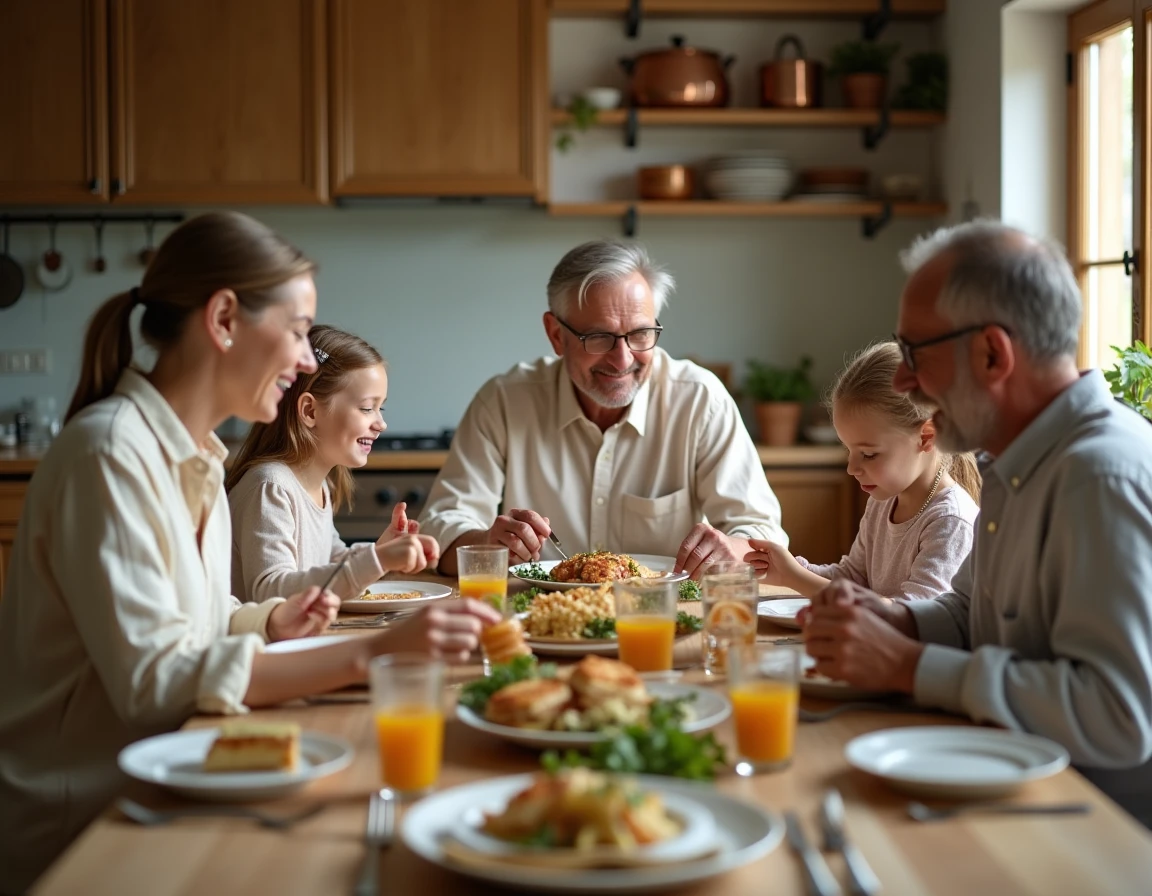
The evening meal turns into a power struggle, mornings feel like a sprint, and the weekend flies by without anyone really catching their breath. These repeated frictions often signal a mismatch between the household’s rhythm and the actual needs of each family member. A few concrete adjustments, inspired by current trends in parenting and home organization, can change the game faster than one might think.
Parental co-housing: sharing daily life among single-parent families

Have you ever noticed how evening tasks seem twice as heavy when handled alone? Single mothers are taking the plunge: they choose to live under the same roof to share the mental load and fixed expenses. The principle is simple. Two or three solo parents rent a shared home and alternate responsibilities (shopping, homework help, school runs).
This shared living model does not replicate student cohabitation. Each family retains its private space. The common areas (kitchen, living room) become a collective living space where children grow up surrounded by other trusted adults. Recent reports describe this trend as a way to recreate a form of “tribe” adapted to current economic realities.
The benefits go beyond the budget. A parent who knows that another trusted adult is present in the house sleeps better, is more willing to go out in the evening, and feels less guilty about working late. For all families on Kali News, this reconfiguration of the household illustrates a profound shift in how family life is perceived.
Giving children a voice in household decisions

The idea is not to turn the home into a permanent general assembly. It involves integrating the child, depending on their age, into the choices that directly concern them. The framework of respectful parenting that honors children’s rights is based on active listening and participation in daily decisions.
Screen time: negotiate rather than impose
Let’s take a concrete example. A nine-year-old child watches videos after school. The classic reaction is to set a time quota. The participatory approach suggests something different: we sit down with them, list possible activities after class (free play, reading, screen time, going out), and build a weekly schedule that they help draft.
The result? The child is more likely to respect a rule they co-created. Friction decreases because the framework is no longer perceived as arbitrary. This method also works for menu choices, weekend organization, or the distribution of small household tasks.
What co-construction changes in daily life
- Conflicts related to rules decrease in frequency because the child understands the “why” behind each decision and feels heard.
- The parent spends less time repeating instructions and more time in positive interaction (play, discussion, shared reading).
- Siblings learn to argue and compromise with each other, which lightens the adults’ arbitration burden.
Residential choices and family quality of life: an underestimated lever
Living better as a family is not solely determined by what happens inside the home. The location where we live shapes the rhythm of the entire week: travel times, access to green spaces, availability of daycare and schools.
Many households are reconfiguring their daily lives by moving to suburban municipalities around metropolitan areas like Toulouse or Lyon. These medium-sized cities are highlighting the rapid expansion of their early childhood offerings, family services, and soft mobility infrastructures.
Choosing your living location based on the household’s needs (and not just the price per square meter) changes the game. A ten-minute walk from home to school frees up forty minutes a day. Forty minutes that can become a stress-free breakfast, a story read in the morning, or simply silence.
Family dietary rebalancing: cooking better without spending the whole evening
Have you ever opened the fridge at 6:45 PM with no idea what you’re going to prepare? The problem is almost never a lack of recipes. It’s the absence of pre-planned decisions.
The trend of family batch cooking addresses this blockage. The principle: dedicate one to two hours on Sunday to prepare the week’s basics (chopped vegetables, cooked grains, homemade sauces). During the week, assembly takes less than twenty minutes.
- Involving children in the Sunday menu choices boosts their desire to try the dishes, including vegetables they would have otherwise refused.
- Preparing two dishes in double quantity and freezing half creates a stock of “emergency” meals for tired evenings.
- Replacing just one processed meal per week with a homemade dish is enough to initiate lasting change, without pressure or guilt.
Family dietary rebalancing works when it remains realistic. One solid change is worth more than five abandoned resolutions. Starting with breakfast (replacing industrial cereals with whole grain bread and a fruit) requires little effort and establishes a visible habit for the children.
Family rituals: creating anchors without rigidity
A ritual doesn’t need to be spectacular. A roundtable in the evening where everyone shares the best moment of their day takes three minutes. This regularity creates an emotional anchor. Children know that this moment belongs to them, which secures and strengthens their sense of belonging to the family group.
The trap would be to multiply rituals to the point of turning daily life into a rigid program. One or two stable rituals per week are enough. The rest can remain spontaneous, adapted to the energy of the moment.
Family life does not improve through a total overhaul. It progresses through repeated micro-adjustments: a living space better suited, a meal prepared differently, a rule discussed with the child rather than imposed. A co-constructed plan on Sunday, a ten-minute shorter commute, one more homemade dish per week.