The same symbol can hide a thousand stories. For the Templars, the diversity of signs is anything but trivial: while most religious or military orders of their time imposed a clear iconography, the mark of the Temple varies, transforms, and slips into ambiguity. A cross changes meaning depending on the region, a seal has different significance on a banner or a ring. The Templars knew how to wield the language of images as one wields a sword: with strategy and nuance.
On authenticated objects, Christian motifs intersect with ancient references. This mix disturbs and questions. Where some religious groups banned any figure, the Templars codified their emblems, juggling with signs despite the prohibitions. This iconographic freedom only thickens the mystery.
Origins of the Templars: Birth of an Order Between Faith and Chivalry
In the tumult of the 12th century, a new brotherhood emerges: the Order of the Temple. Jerusalem, 1120. Hugues de Payns and Godfrey of Saint-Omer gather around them a handful of knights determined to protect pilgrims in the Holy Land. Supported by Baudouin II, King of Jerusalem, and then officially recognized by the Catholic Church at the Council of Troyes in 1129, they settle not far from the Temple of Solomon, under the Dome of the Rock. This location is no coincidence: every step, every stone resonates with the memory of the Ark of the Covenant.
Strict discipline, austere life: the Templar rule leaves little room for half-measures. Their white cloaks, emblazoned with a red cross, are more than just a uniform. They signify purity, faith, but also martial determination. The symbols of the Templars, the pattée cross, the seal showing two knights on a single mount, bear the mark of a dual project: to live evangelical poverty, but also to unite the group in trial, both in the field and in prayer.
The order is a crossroads. Christianity, ancient heritage, secret traditions: everything converges in its spirituality. Bernard of Clairvaux inspires the rule, Malachy Ua Morgair mingles with the first Templars, while echoes of druidism or alchemy nourish their imagination. The cross, the seal, and even the architecture of the commanderies become supports for messages, vectors of transmission, sometimes with double meanings. For those who want to understand the power of these signs, it is better to consider the chivalric symbolism, the circulation of knowledge, and the diversity of forms used.
By combining history, theology, and the art of war, the Templars invent a visual grammar that leaves a lasting imprint on Europe. In less than a century, they facilitate a dialogue between Jerusalem and France, deep spirituality and concrete commitment. Their legacy still resonates in the collective imagination.
What are the Major Symbols of the Templars and What Do They Really Conceal?
It is impossible to mention the order without citing the Templar cross. Red, pattée, it appears on cloaks, shields, and banners. Emerging in the 13th century, it derives from the Greek cross and recalls the letter Tav from the Hebrew alphabet. Its bright red hue intrigues: it evokes light, but also the blood of sacrifice, the transformation dear to alchemists, the famous rubedo. Officially attributed by Pope Eugene III, this cross becomes the sign of an unshakeable faith, a call for divine protection, but also a promise of passage to the beyond.
Another foundational motif dominates: the Templar seal. Two knights on a single horse. The image strikes with its strength: it tells of brotherhood, the poverty of origins, the solidarity of those who share everything, even the mount. But this seal suggests more: it refers to a fundamental duality, to companionship, to the ancient myths of the Dioscuri, or to the legendary Bayard. The inscription “sigillum militum xpi sti,” the seal of the soldiers of Christ, anchors these knights in their sacred mission.
The Malta cross, with eight points, enriches this vocabulary. More than a decorative emblem, it refers to the eight beatitudes, the eight languages of the order, the virtues of the knight. Sometimes engraved on Templar jewelry, it interacts with the red cross to shape a strong heraldic identity, immediately recognizable, from medieval commanderies to contemporary works.
Finally, there is the baussant, a black and white banner. It symbolizes the ongoing struggle: light against darkness, purity against trial. On the battlefield, this visual contrast galvanizes the troops, reminding them that the ideal is forged in confrontation.
Between Spirituality, Mysteries, and Heritage: The Secret Significance of Templar Emblems
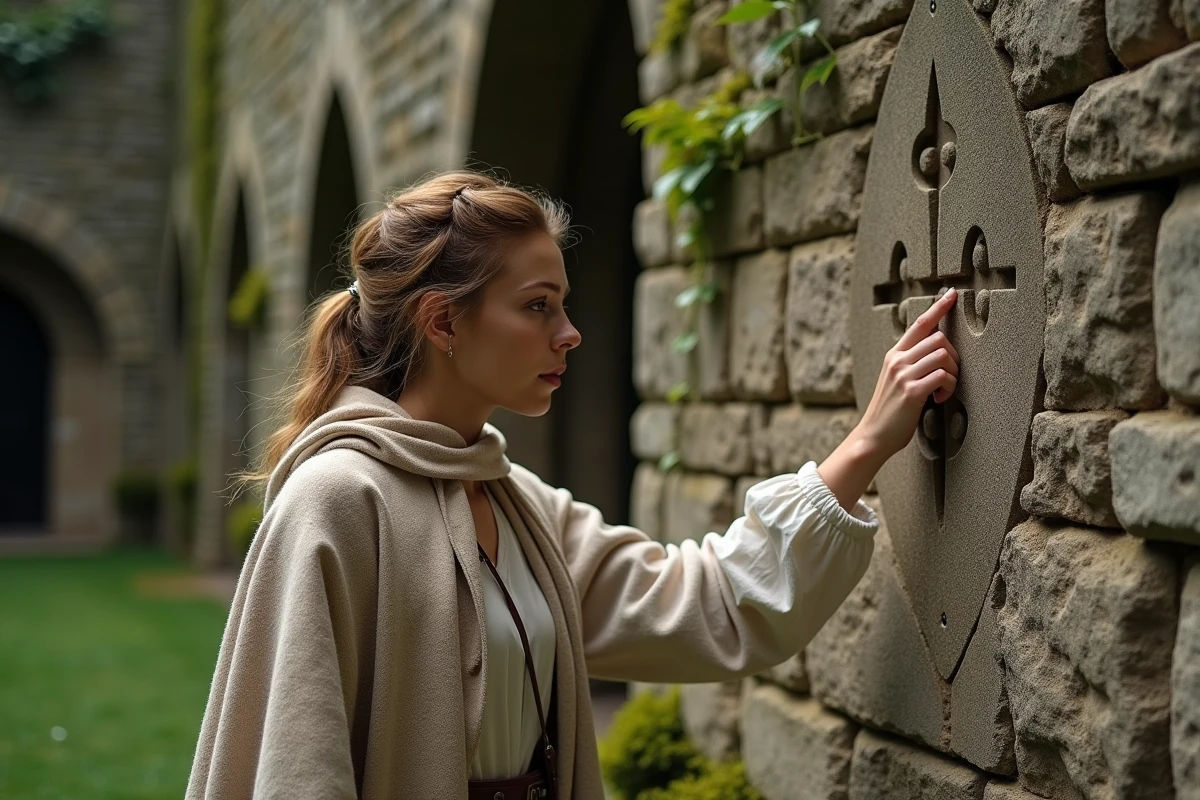
Templar spirituality is expressed through a complex network of signs. Cross, seal, baussant: each symbol interacts with myth and the sacred. The seal, showing two knights on a mount, transcends the simple evocation of solidarity or initial poverty. It embodies a universal duality, draws from the figure of the Dioscuri, mythological brothers, and echoes the alternation of the seasons. Some researchers even see a reference to the constellations of Orion and Ophiuchus, linked to John the Evangelist and John the Baptist. Thus, Templar symbolism connects to astronomy and Christian spirituality.
To understand the richness of these figures, one must consider the characters that structure the imagination of the order:
- John the Baptist and John the Evangelist: protectors, inspirers, sometimes perceived as a double face, a Christian Janus that connects body and spirit.
- Mary Magdalene and the Virgin Mary: female figures associated with the quest for the Grail, the transmission of hidden knowledge or a legacy to decode.
The early 14th century plunges the order into turmoil: accused during heresy trials, suspected of secret rituals, the Templars see their reputation shift into mystery. Their emblems traverse the centuries, igniting curiosity, inspiring novels, films, or jewelry, and extending their influence far beyond mere military exploits.
In the shadows of medieval chapters or on the worn stones of the commanderies, each Templar symbol continues to defy clarity, telling a story that is both intimate and universal. Who today has never encountered that two-faced gaze, between shadow and light?