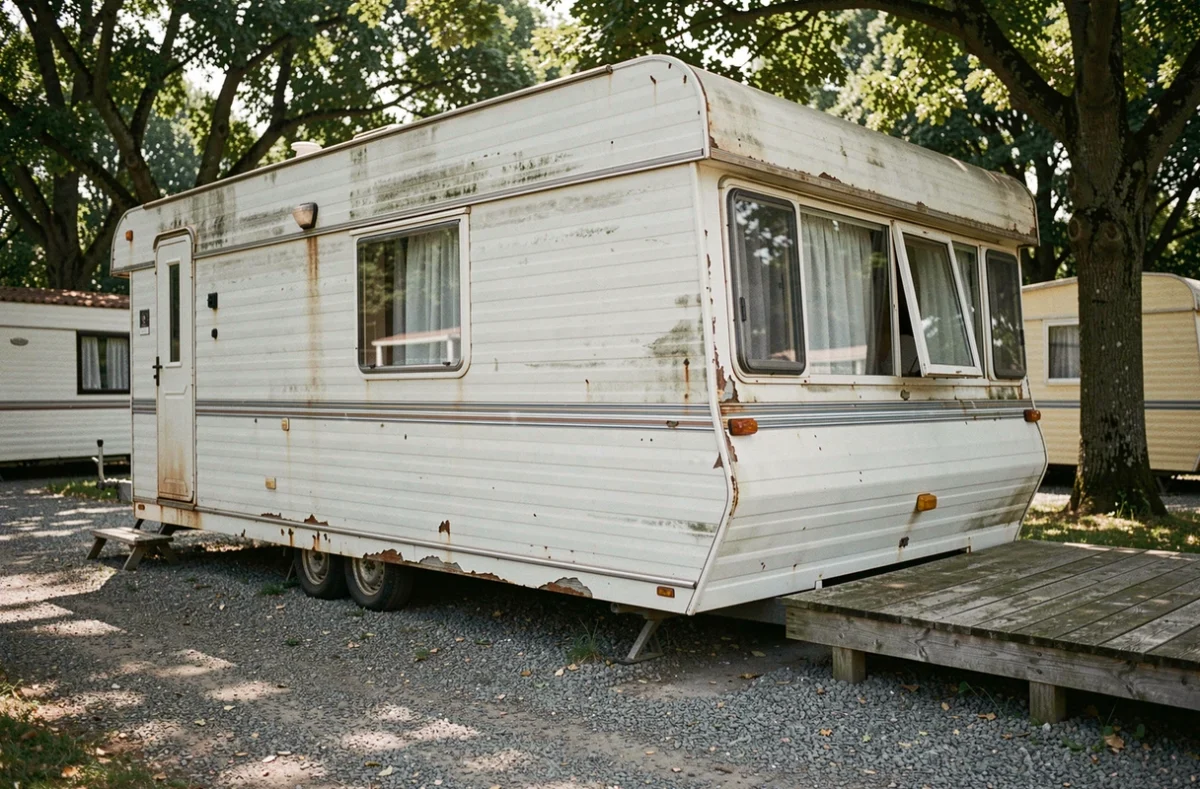
A mobile home, in the sense of the decree of January 5, 2007, is a mobile leisure residence (MLR): a habitable land vehicle intended for temporary occupancy, which must retain its means of mobility (wheels, towing bar) and cannot circulate on public roads. This legal qualification distinguishes it from a conventional construction and determines all the rules applicable to it, regardless of its age.
The question of the 20-year threshold constantly arises among owners faced with a replacement request from the campsite manager. Understanding the actual framework helps avoid costly decisions made under pressure.
Absence of law imposing an age limit on mobile homes
The starting point is clear: no French legislative text sets a maximum lifespan for a mobile home. Neither the Tourism Code nor the Urban Planning Code mentions a threshold of 20 years, 25 years, or any other age at which an MLR should be removed or replaced.
The confusion often arises from the commercial practices of campsites. Many managers include in their internal regulations or in the plot rental contract a clause limiting the presence of mobile homes beyond a certain age. This clause does not stem from any legal obligation. It falls exclusively under private law, meaning what has been agreed upon between the mobile home owner and the land operator.
To properly understand the legislation on mobile homes over 20 years old, one must refer to the signed contract and not to a hypothetical legal text.

Plot rental contract: the real legal framework
The document that governs the relationship between a mobile home owner and the campsite is the plot rental contract. It sets the duration, renewal conditions, maintenance obligations, and, if applicable, restrictions related to the age or condition of the mobile residence.
Obsolescence clauses: what is legal and what is not
An obsolescence clause may appear in the contract. It becomes problematic when it allows the manager to unilaterally decide, without objective criteria, that a mobile home is too old or unsightly.
The Court of Cassation (3rd civil chamber, June 10, 2009, No. 08-13.797) ruled that a clause allowing the landlord to unilaterally assess the obsolescence of a mobile residence was abusive. This decision establishes a clear principle: the manager cannot unilaterally decide that a mobile home must leave.
Annex II of the decree of February 17, 2014, also stipulates that the assessment of a mobile home’s condition must consider several verifiable criteria:
- The interior and exterior condition of the structure (walls, roof, joinery)
- The chassis and means of mobility (wheels, axles, towing bar)
- Safety equipment (electrical, gas, ventilation installations)
A clause that ignores these criteria and relies solely on the year of manufacture can therefore be challenged in court.
Exit fees and questionable practices
Some campsites charge exit or replacement fees to owners who refuse to change their mobile home. A ruling from the judicial court of Draguignan (March 19, 2025, RG No. 24/06023) deemed such a clause abusive because the service supposed to justify the payment was not identifiable. Fees without a corresponding specific service can be annulled by the judge.
NF S 56-410 standard and technical obligations of old mobile homes
The NF S 56-410 standard regulates the design, manufacture, and installation of mobile leisure residences. It applies from the origin of the mobile home, but its requirements remain relevant throughout its life.
For a mobile home over 20 years old, the technical points to monitor primarily concern the strength of the chassis, the waterproofing of the roof and walls, as well as the compliance of gas and electrical connections. A well-maintained old mobile home, whose chassis is not corroded and whose installations meet safety standards, has no legal reason to be removed.
Regular maintenance is the best argument against a manager who would invoke obsolescence. Keeping invoices for work, inspection reports, and dated photographs helps demonstrate the actual condition of the residence in case of a dispute.
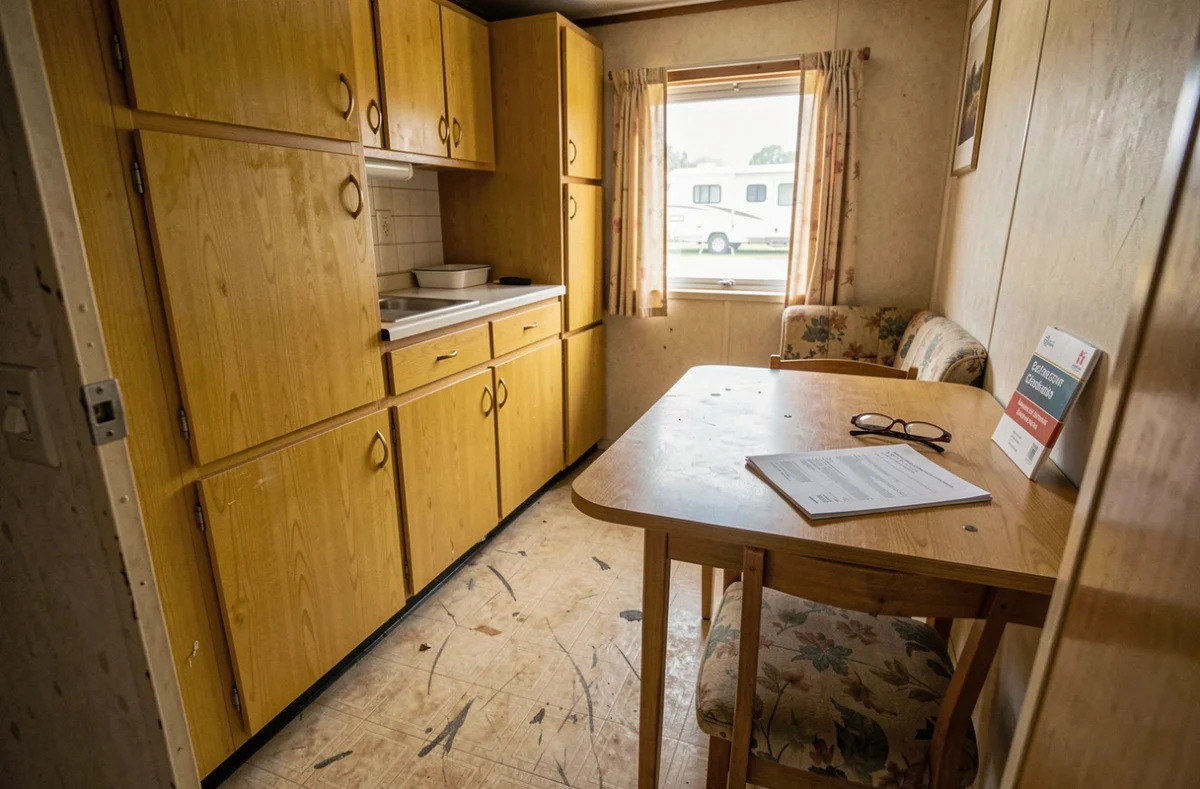
Mobile leisure residence on private land: urban planning rules
Installing a mobile home on private land follows distinct rules from those of campsites. The Urban Planning Code requires that MLRs be placed in authorized structures: classified campsites, residential leisure parks (RLP), or classified holiday villages.
Placing a mobile home on unprepared private land is prohibited, except for very specific exceptions (use in the garden of a primary residence, for a limited duration and without permanent connections). The municipality may require removal under penalty in case of violation of the urban planning code.
This constraint particularly weighs on owners of old mobile homes who, after a dispute with a campsite, consider moving their residence to personal land. The move itself requires an exceptional convoy, as the mobile home cannot circulate on public roads.
What to check before buying or keeping a mobile home over 20 years old
Three elements deserve special attention:
- The plot rental contract, specifically the presence or absence of an obsolescence clause with verifiable objective criteria
- The actual technical condition of the mobile home (chassis, waterproofing, gas and electrical installations) documented by inspections or maintenance invoices
- The applicable taxation, particularly the residence tax on secondary residences and the business property tax if the mobile home is rented
The death of the owner does not automatically terminate the plot rental contract. Article 1742 of the Civil Code provides that the lease is not resolved by the death of the tenant. Heirs can therefore take over the ongoing contract, but a contract that has expired is not renewed by operation of law.
A mobile home over 20 years old remains perfectly legal as long as its technical condition allows it and the plot contract does not provide for a valid restriction. The key for any owner lies in the careful reading of the signed contract and the systematic preservation of maintenance evidence.