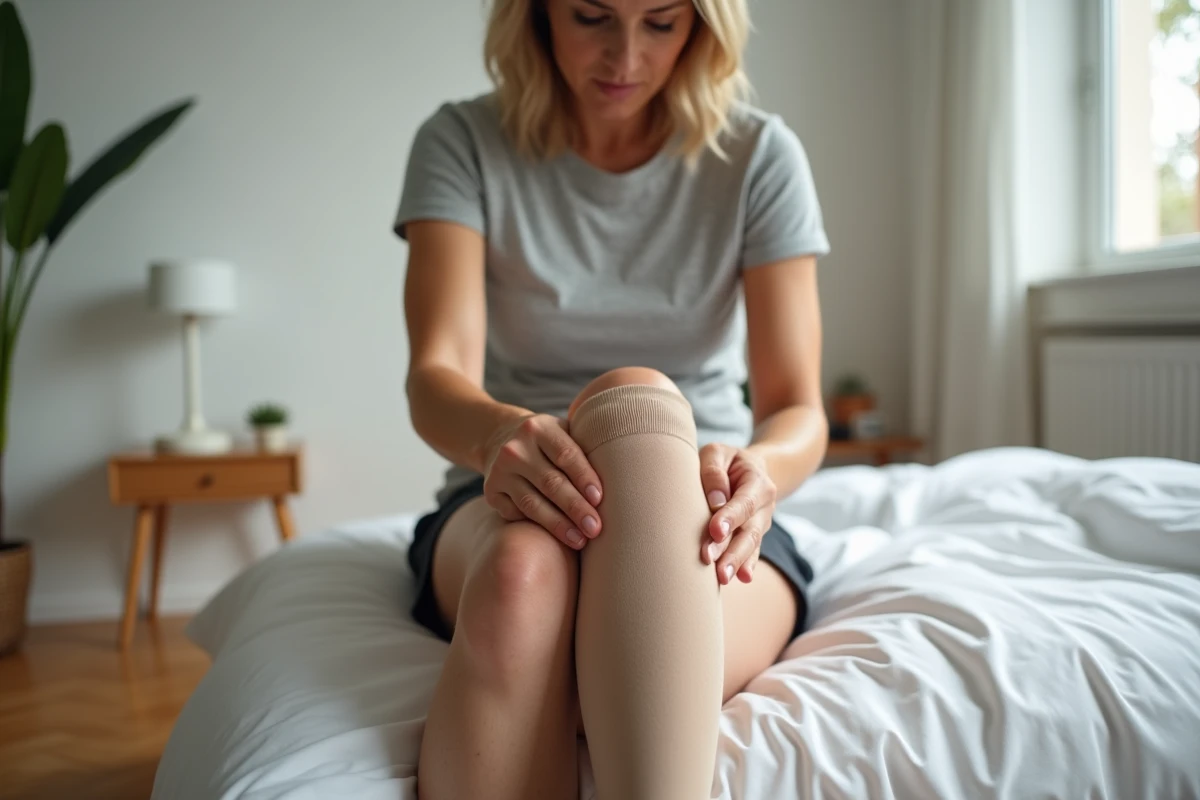
A compression stocking that has been holding perfectly for weeks and suddenly starts to slip in the middle of the day is not just a comfort issue. It is a signal that something has changed, either with the leg or the fabric. Before adding more support accessories, it is worthwhile to identify the real cause of the slipping.
Silicone band and maintenance: the primary cause of slipping compression stockings
In practice, most of the slipping observed comes from a problem with the self-adhesive silicone band. Over time, this band accumulates residues from moisturizing cream, sweat, and textile fibers. Its adhesive power decreases, sometimes in just a few days if a greasy treatment is applied in the morning before putting on the stocking.
The effective reflex: wash the silicone band every day with warm water and regular detergent, then rinse thoroughly. An occasional cleaning with 45° alcohol helps to remove stubborn residues and restore adhesion. Some orthotists also recommend regular exfoliation of the skin at the thigh level, followed by a light lotion (not a greasy cream) to ensure that the skin surface provides a good grip.
One might wonder what to do if compression stockings slip despite careful maintenance. In this case, the problem often lies elsewhere than with the band.
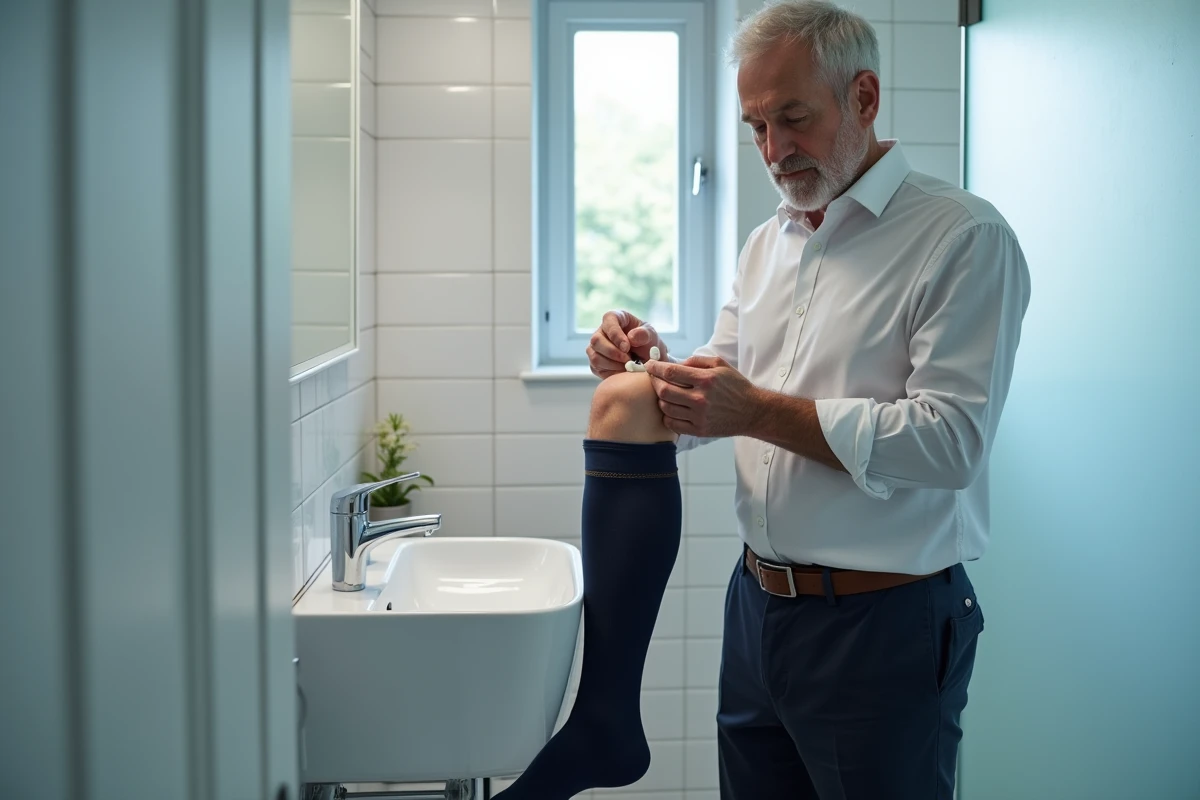
Inappropriate size and fluctuation of edema: the re-measurement that is often overlooked
A compression stocking is chosen based on precise circumference measurements taken in the morning when the leg is the least swollen. A gain or loss of weight, even just a few kilos, is enough to make the size inadequate. The stocking becomes too loose at the thigh, and the self-adhesive band no longer holds.
Feedback from orthotists indicates a lesser-known phenomenon: edema that fluctuates throughout the day changes the thigh circumference between morning and evening. Under diuretic treatment or after lymphatic drainage sessions, the volume of the leg can significantly decrease within a few hours. A stocking that fits well in the morning may feel loose by late afternoon.
Rather than adding a stocking holder or textile glue, requesting a re-measurement at the pharmacy or from the orthopedist often resolves the issue at its source. It is recommended to check measurements every six months or as soon as a change in weight or treatment affecting water retention is noticed.
When the size is correct but the model is not suitable
The type of band varies from one manufacturer to another. Thuasne and Sigvaris now certify the precise composition of their self-adhesive bands (type of silicone, possible presence of latex) on the labels and packaging. This detail matters: a standard silicone band on dry or thin skin does not react the same way as a micro-perforated silicone band on skin that sweats a lot.
If the stockings slip despite the correct size, one might consider:
- A model with a wider silicone band, which distributes pressure over a larger surface area of the thigh and limits rolling effects
- Medical garter stockings, which completely eliminate the need for skin adhesion, an often underestimated but very effective option in cases of skin intolerance
- A full compression pantyhose, which removes the issue of support at the thigh level since the fabric is held up by the waist
Sudden slipping of compression stockings: identifying a medical warning sign
When stockings that have held properly for months begin to slip for no apparent reason, one should not first look for a support trick. Instead, one should investigate what has changed with the leg.
Three situations should raise concern:
- Increased edema: if the leg swells more than before, the thigh circumference increases during the day beyond what the stocking can accommodate. The slipping then indicates a worsening of venous or lymphatic insufficiency, not a textile issue
- Skin reaction under the band: persistent redness, itching, contact eczema. Dermatologists have reported cases of reactions linked to certain compositions of anti-slip bands. If the skin rejects the band, the stocking will no longer hold, and forcing the fit with glue or a stocking holder worsens the irritation
- Rapid morphological change: involuntary weight loss, muscle wasting, new water retention. Any change in thigh volume within a few weeks warrants medical advice before purchasing a new pair
The sorting criterion is simple: if the stocking has been slipping since day one, it is a problem of choice or fitting. If the stocking held well and suddenly no longer does, a consultation is necessary.

Fitting technique and daily support accessories
The fitting itself influences the hold throughout the day. The stocking is put on in the morning, with a dry leg, before applying any cream or oil. The technique involves turning the stocking inside out to the foot, positioning the toe on the toes, and then gradually unrolling it without pulling on the upper band. Pulling directly on the top of the stocking distorts the elastic and shifts the silicone band, which no longer ends up in the thigh area intended by the manufacturer.
Complementary accessories for maintaining stockings
When maintenance is good, the size is verified, and the fitting technique is correct, a few complementary solutions exist. A medical garter belt offers mechanical support independent of skin adhesion, suitable for sensitive skin or long days with a lot of movement. Adhesive strips like stocking holders, applied to clean, dry skin, can provide occasional assistance.
Feedback varies on this point: some people find the stocking holder uncomfortable after several hours, while others use it daily without issue. The choice depends on skin sensitivity and activity level.
The most cost-effective reflex remains to address the problem upstream. A compression stocking in the correct size, with a band suitable for one’s skin type and washed daily, should not slip. When it does slip, the answer is not to add another accessory, but to visit the healthcare professional who prescribed it.