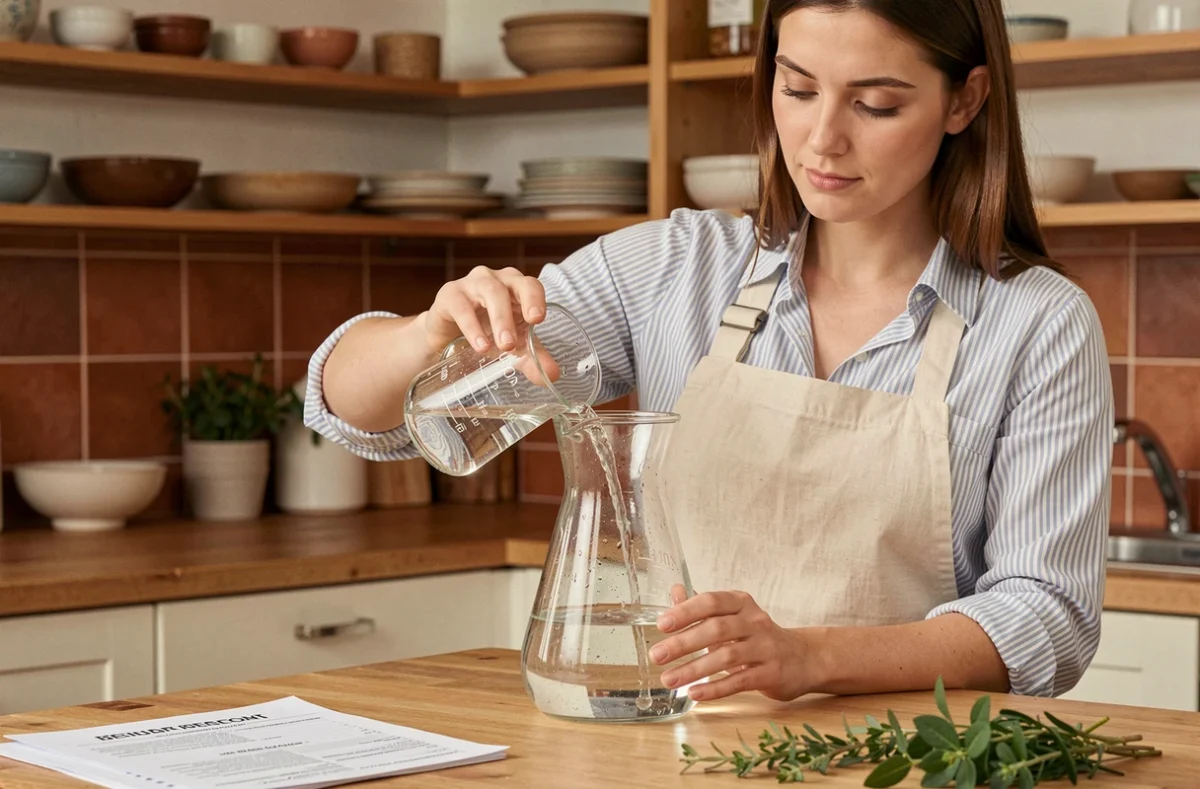
We pour 200 ml of milk into a measuring cup, but the recipe asks for the quantity in liters. This kind of discrepancy between the units displayed on the packaging and those in the cookbook slows down preparation for no reason. The rule to remember: 200 ml corresponds to 0.2 liters, or one-fifth of a liter. This is the foundation, and everything else follows from it.
Milliliters and liters: what the geometric relationship changes in cooking
The liter is not a base unit of the International System, but its use is legally permitted. The fundamental relationship remains simple: 1 liter equals 1,000 milliliters. In other words, 1 ml corresponds to 1 cm³.
To convert from milliliters to liters, we divide by 1,000. For 200 ml: 200 ÷ 1,000 = 0.2 L. No need for a chart, no need for an app. This division works for any volume.
In practice, when dealing with the conversion of 200 ml to liters, we are working with one-fifth of a liter, which also corresponds to 20 centiliters. Knowing how to navigate between ml, cl, and L avoids rounding errors when adapting a recipe for more or fewer guests.
Here are some common reference points to anchor this logic:
- 100 ml = 0.1 L = 10 cl (a small amount in a measuring cup)
- 250 ml = 0.25 L = 25 cl (a large glass or a quarter of a liter)
- 500 ml = 0.5 L = 50 cl (a half-bottle)
- 750 ml = 0.75 L = 75 cl (a standard wine bottle)
With these benchmarks in mind, we can interpolate easily. 200 ml is between 100 and 250, so between 0.1 and 0.25 L. We confirm: 0.2 L.
Measuring 200 ml accurately: the measuring cup is not always enough
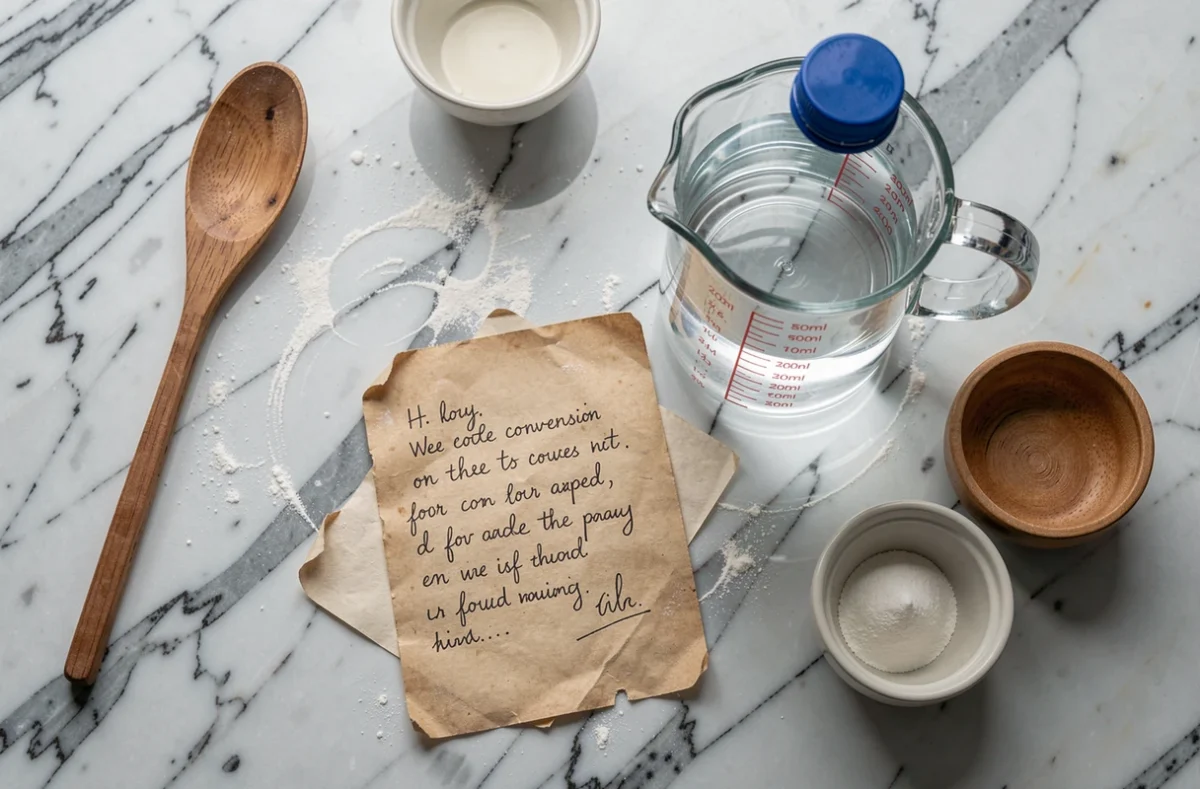
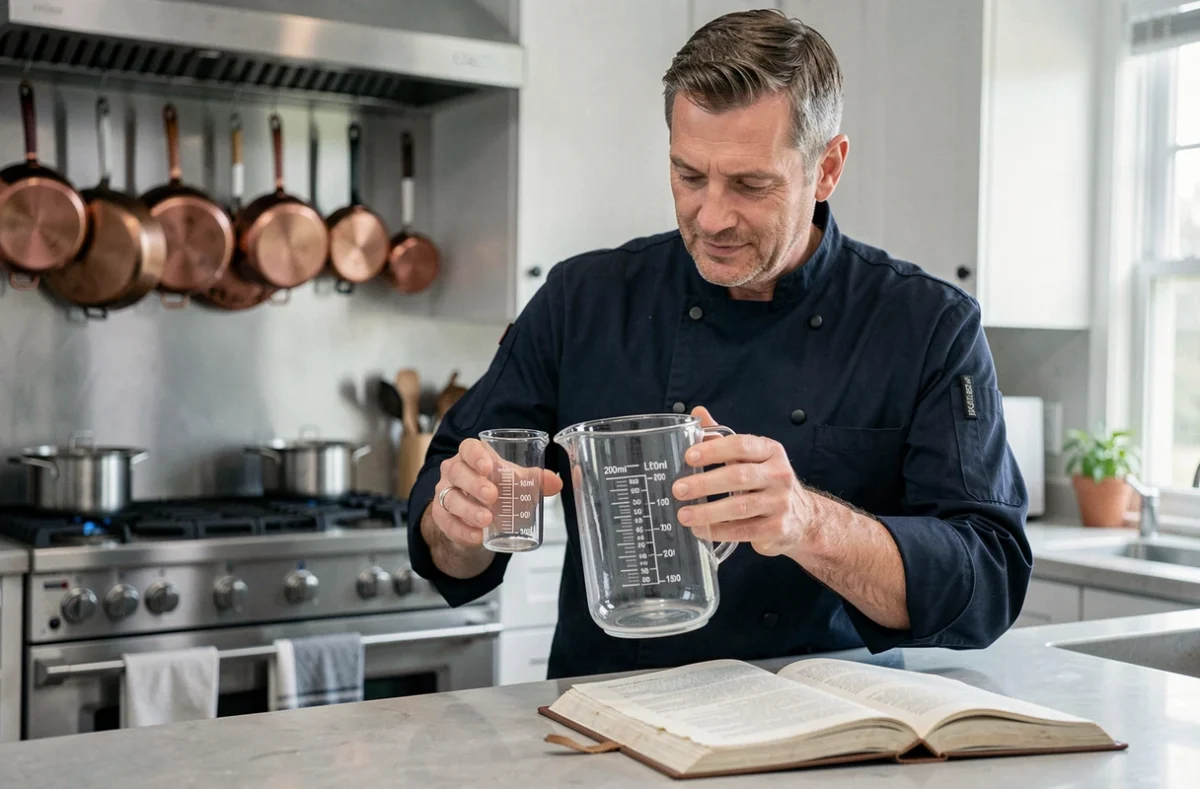
The formula is simple, but accuracy depends on the tool used, not the calculation. A large one-liter graduated pitcher has spaced graduations. Identifying exactly 200 ml on this type of container remains approximate, especially when pouring by hand.
To obtain a reliable measurement, we prefer a small graduated container, like a test tube or a small 250 ml measuring cup. The graduations are closer together, making them more readable.
Reading the meniscus correctly
Water and most liquids form a curve at the surface, called a meniscus. We read the volume at the bottom of the meniscus, with our eyes level with the liquid, the container placed on a horizontal surface. Reading from above or below skews the measurement by a few milliliters, which is enough to throw off a vinaigrette or syrup.
Feedback varies on this point, but a reading discrepancy of 5 to 10 ml on a volume of 200 ml can significantly alter the result of pancake batter or an emulsified sauce.
Conversion ml to grams: the density trap in cooking
It is often said that 200 ml equals 200 g. This is true for water under normal conditions, but this equivalence does not apply to all ingredients. The reason lies in density, which varies from product to product.
200 ml of oil weighs less than 200 g. 200 ml of honey weighs significantly more. And 200 ml of flour, depending on whether it is packed or aerated, gives a very different weight. Confusing volume and mass is the most common mistake when following a recipe without a scale.
Measuring cup: volume graduations and mass graduations
Some measuring cups display graduations in ml on one side and in grams on the other, for specific ingredients (flour, sugar, rice). These mass graduations are calibrated according to the average density of each ingredient. Using the “flour” graduation for powdered sugar gives an incorrect result.
When precision is needed, the kitchen scale remains the most reliable tool. The measuring cup is used for liquids; the scale, for solids and powders.
Food labeling and volumes: understanding what we read on the packaging
Liquid food packaging in Europe indicates the net volume in liters, centiliters, or milliliters. For products under one liter, displaying in ml or cl is common. A carton of cream will display “200 ml” rather than “0.2 L,” because it is more readable for the consumer.
The labeling units do not change the quantity, only the presentation. We find 200 ml in the form of “20 cl” on some pots of fresh cream, or “0.2 L” on bottles. It is always the same volume.
A useful reflex when grocery shopping: check the unit on the packaging before comparing it to that of the recipe. A French recipe often indicates liquids in cl, while a converted Anglo-Saxon recipe will use ml.
Summary of practical conversions around 200 ml
| Volume | In liters | In centiliters | Common equivalent |
|---|---|---|---|
| 100 ml | 0.1 L | 10 cl | Coffee cup |
| 150 ml | 0.15 L | 15 cl | Small glass |
| 200 ml | 0.2 L | 20 cl | Mustard glass |
| 250 ml | 0.25 L | 25 cl | Large glass |
| 330 ml | 0.33 L | 33 cl | Standard can |
This table covers the volumes we handle most often in daily cooking. Converting 200 ml to 0.2 liters becomes second nature once we have integrated the logic of dividing by 1,000.
The most effective way to stop hesitating: keep a small 250 ml measuring cup handy, read at the meniscus, and reserve the scale for dry ingredients. With these two tools, the question of conversions no longer slows down preparation.