
The registration certificate, also known as the gray card, is an official police document that allows for the identification of a vehicle and authorizes it to circulate. The gray card contains information related to the driver or drivers as well as general and technical information about your vehicle. Note that in 2009, there were changes such that the document was updated in accordance with the new vehicle registration system SIV. Nowadays, the information on the gray card is organized by codes, ranging from A to Z. So how can you read your gray card? Read this article to learn more.
Information on registration
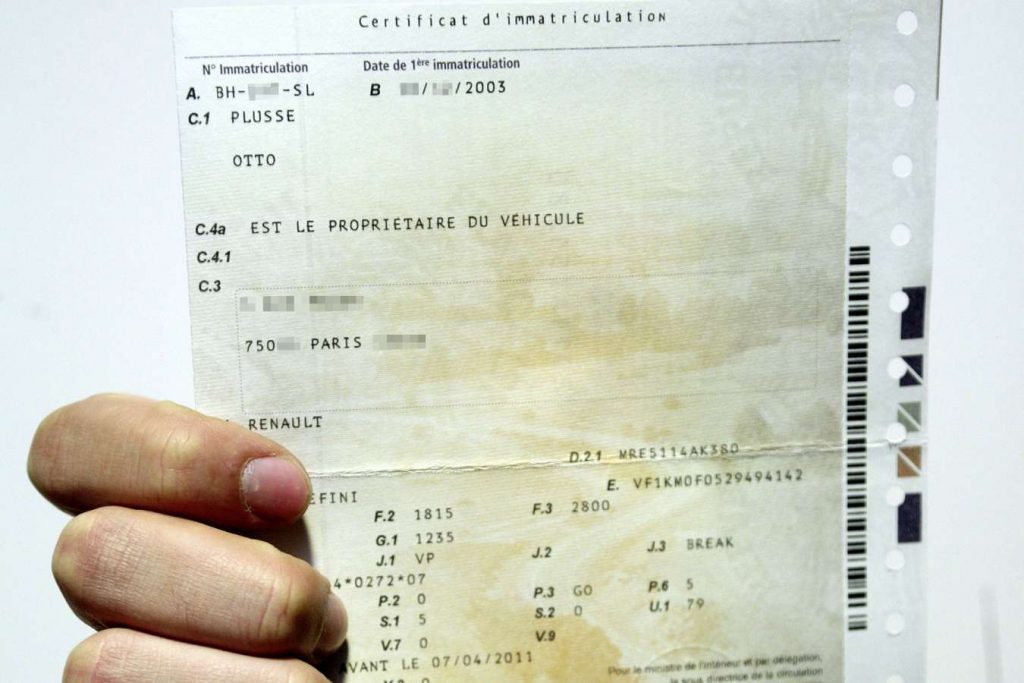
When you are in possession of your gray card, it is crucial that you know how to read a gray card. Furthermore, remember that the information on registration pertains to fields A and B. Field A corresponds to the vehicle’s registration number, which you will also find on the license plates. However, field B indicates the date of the first registration of the vehicle. In other words, it is the date of the first entry into circulation.
Information on the holder of the gray card
The information on the holder of the gray card corresponds to field C. This is subdivided into subcategories C.1 to C.3. In C.1, you have the identity of the buyer of the vehicle with the name and surname identical to those on the transfer certificate. In C.4a, you have the assurance that the person indicated in C.1 is indeed the owner of the vehicle. In C.4.1, you have the identity of the co-holders who can use the vehicle. These must appear on the transfer certificate and also on the registration application form. Finally, in C.3, you have the complete address where the vehicle was registered. In case of a change of address, it must be updated on the card.
General information about your vehicle
The general information regarding your vehicle corresponds to fields D and E. Regarding field D, you have the details of the vehicle’s characteristics. In D.1, you have the name of the vehicle’s brand written in full. In D.2, you have the code used that includes the type, variant, and version of the vehicle. In D.2.1, you have the national identification code of the useful type. This is the useful type when importing a vehicle from one member state to another EU member state. Finally, in D3, you have the commercial designation of the vehicle. As for field E, it provides the identification number of your vehicle known as the serial number or chassis number. You will find it in several places in your vehicle so that it can be identified in case of an accident.
Other information about the vehicle
The information about the vehicle ranges from fields F to Z. Note that fields F to Z address or include technical information. The F fields indicate the maximum authorized weight, which is the maximum technically admissible load. It is defined by the vehicle manufacturer, and exceeding it may be considered risky. Next, the G fields indicate the weight of the vehicle in service with bodywork and towing device as well as the unladen weight. Additionally, the J fields provide the vehicle category, national genre, body type according to European standards, and body type according to national standards. As for the K fields, they correspond to the type approval number and are intended for imported vehicles.
Moreover, you will also see four fields ranging from P.1 to P.6 that provide information on the energy and power of the vehicle. Through these fields, you have information on the engine capacity, maximum net power, type of fuel, and national administrative power or fiscal horsepower. Note that the higher the number of horsepower, the higher the price of the gray card. The Q field provides the power-to-weight ratio in kg/KW. S.1 indicates the number of seating places including that of the driver, and S.2 the number of standing places.