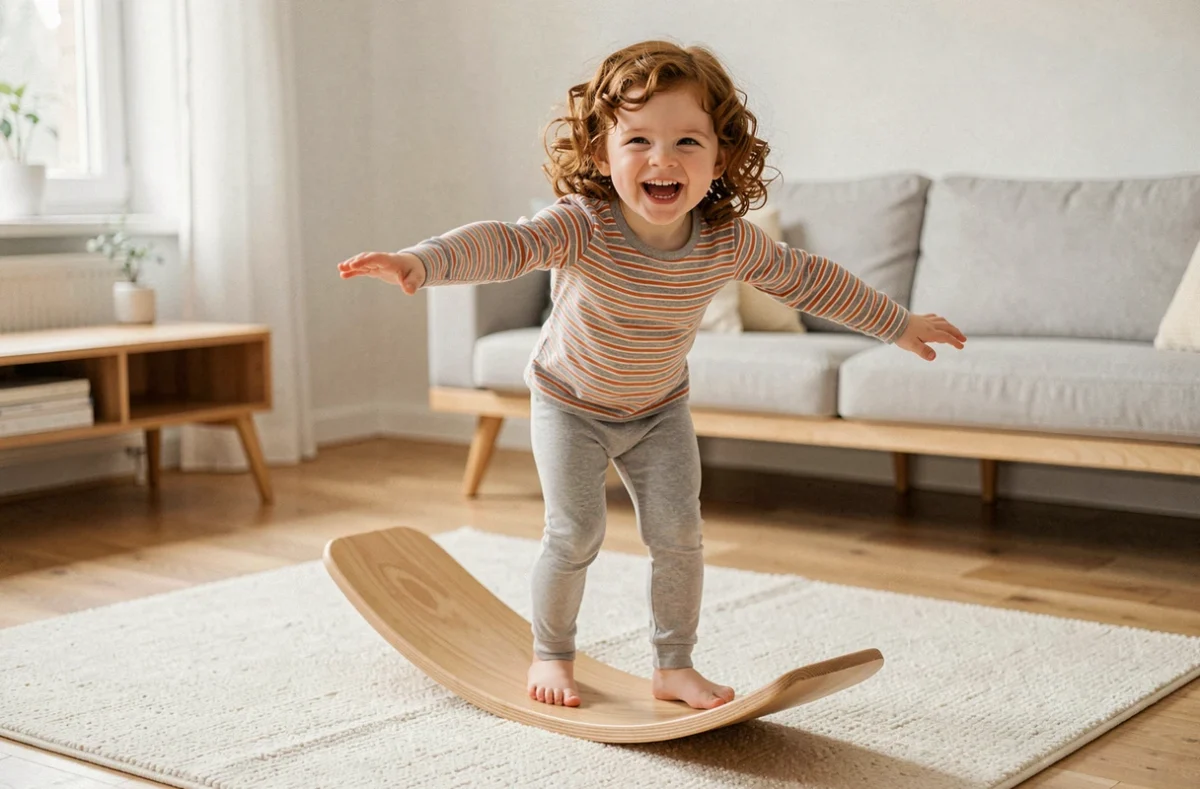
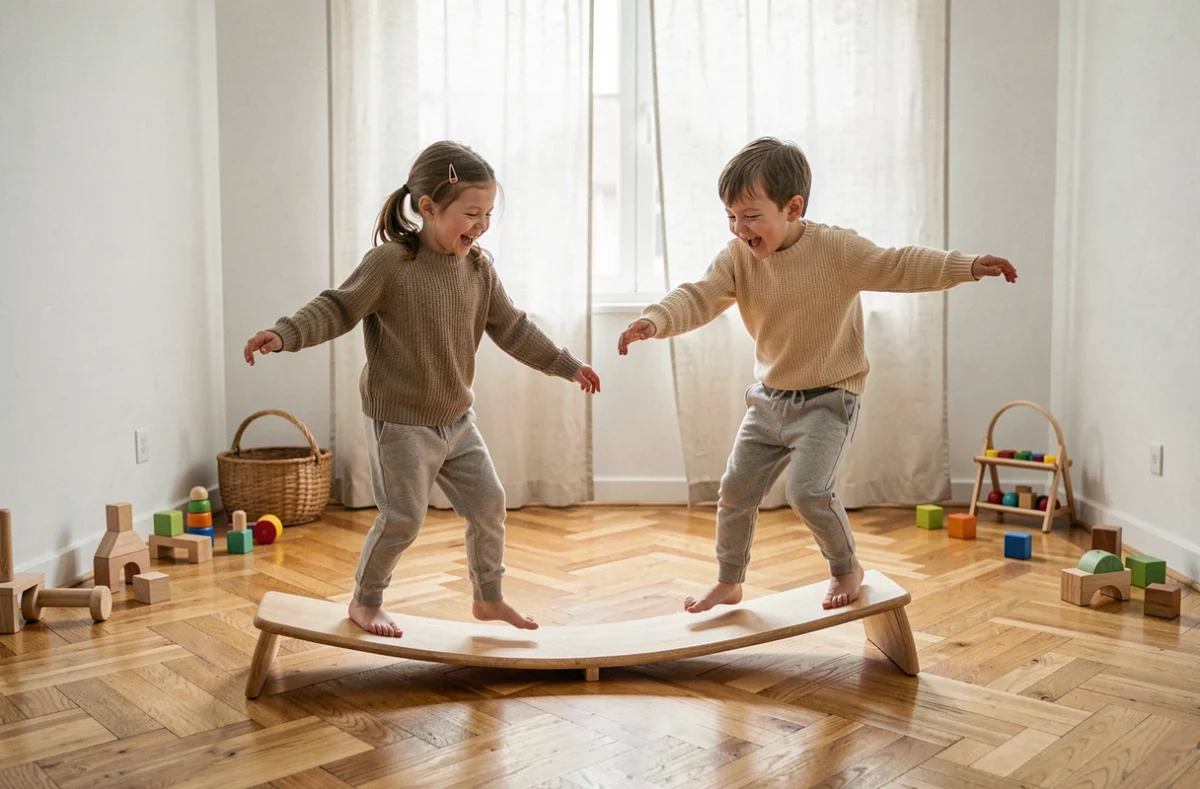
A three-year-old child turns the board over, sits inside it like a little boat, and rocks back and forth for twenty minutes. No one showed them how. This is exactly the kind of scene that explains why the Wobbel board wins children over before anyone even explains how it works. The curve of the wood invites movement, and movement does the rest: the child adjusts their posture, engages their stabilizing muscles, and works on their balance without instructions or a set goal.
The Wobbel board’s curve and the muscles it engages
The Wobbel’s curved shape is not just decorative. It creates an unstable surface that makes the body constantly compensate. Standing up, the child contracts the muscles in their ankles, calves, and torso to stay upright. Sitting down, their pelvis rocks while their deep abdominal muscles work quietly in the background.
Toddlers often start by kneeling or lying on their stomach on the board, then gradually move to standing over the following weeks. This spontaneous progression follows the development of the vestibular system: the inner ear sends information that the brain learns to interpret more precisely with each session.
The WHO’s recommendations on physical activity for children emphasize regular movement for health and overall development. The Wobbel board offers a practical way to get moving every day, including on rainy days when a trip to the park is off the table. Its benefits have less to do with any magical property of the product than with the simple fact that children move, repeat, and freely adjust their movements.
To better understand what sets the original Wobbel board apart from other balance boards, take a look at how it is made: several layers of FSC-certified European beech are stacked and bent under high pressure in a workshop in the Netherlands. The result is a board that is both flexible and durable, and can support an adult’s weight.
Balance boards and free play: why children keep coming back to them
A slide has an unspoken set of instructions: climb up, slide down, and do it again. The Wobbel board doesn’t. It’s this lack of a predefined purpose that holds children’s attention for so long.
In practice, children use it in all sorts of ways, depending on their age and mood:
- A rhythmic rocker, often accompanied by songs or nursery rhymes, that develops coordination and a sense of rhythm.
- A bridge or tunnel in an improvised movement course made with cushions, with the board serving as a ramp or raised passageway.
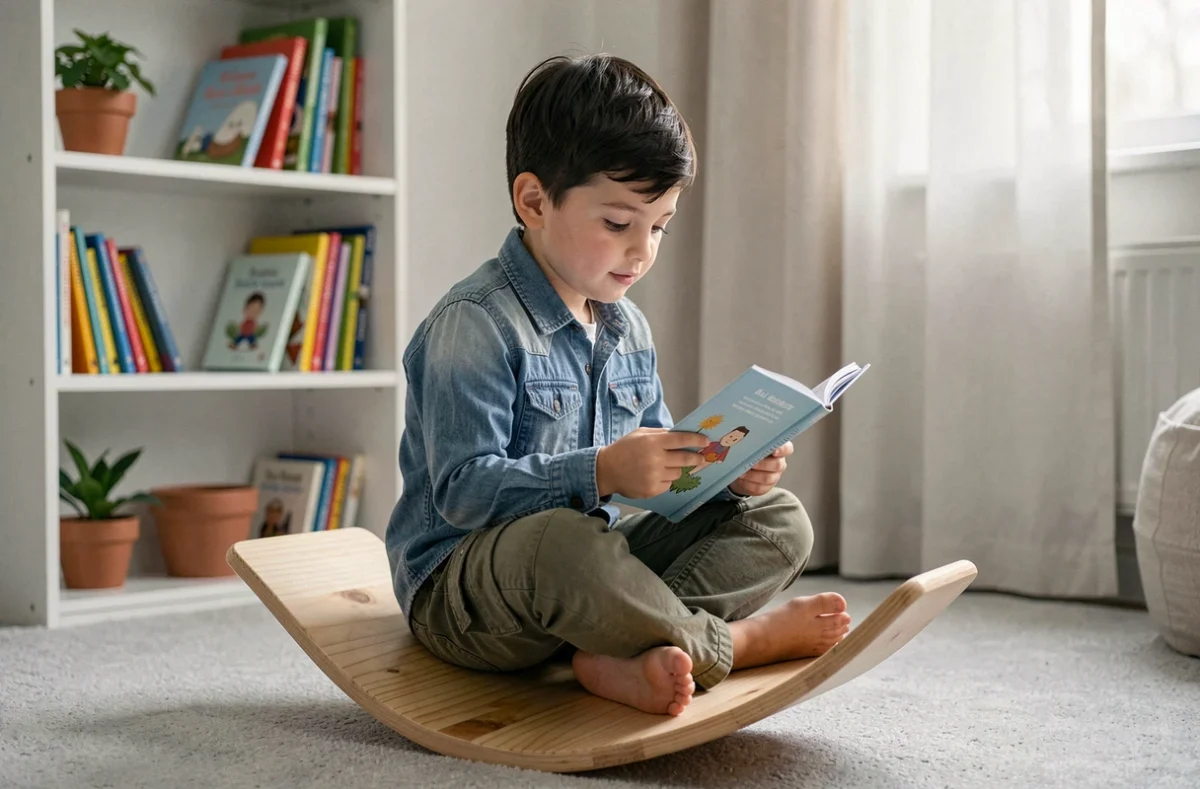
- An upside-down reading seat, with the curve forming a comfortable hollow that encourages an upright, engaged posture.
- A yoga surface for balance poses (tree, warrior)—a combination highlighted by several specialist retailers for children aged four or five and up.
The child decides how to use it, and the way they use it changes every day. This freedom reflects what Montessori and Pikler approaches describe as free play, where learning happens through independent exploration rather than instruction.
Attention span and keeping things interesting
Toys with a single function (one button, one sound) quickly lose their appeal because the feedback loop is always the same. On the Wobbel, the feedback changes with each movement: a stronger push creates a wider rocking motion, while shifting a foot changes the rocking axis. The toy doesn’t lose its appeal because the child grows and discovers new possibilities as their motor skills develop.
Choosing a Wobbel based on your child’s age and weight
We’re often asked which size to choose. The Wobbel range comes in several sizes, and the choice depends on two practical factors: the child’s age and the maximum weight it needs to support (including adults, if the whole family will use the board).
The Wobbel Starter is suitable for children who can walk steadily, typically from around eighteen months, with a shorter length and a gentler curve that limits the rocking range. The longer Original model is suitable for children from around three years old and can also support an adult. The Wobbel Pro, designed for taller users or more intensive activities (yoga, fitness), has a wider surface.
Each model is available in unfinished wood or with a pressed wool felt covering attached to the underside. The felt serves two purposes: it softens the sound of rocking on a hard floor and protects the floorboards. On a thick rug, the version without felt works very well. On tile, felt noticeably reduces noise and prevents slipping.
Unfinished, lacquered, or stained wood: what changes in everyday use
Untreated beech wood retains its natural feel and develops a patina over time. Lacquered or stained versions are more resistant to stains, which is worth considering if the board will also be used as a pretend-play table. In both cases, the wood is FSC-certified, ensuring traceability from the forest to the finished product.
Safety and care for a wooden Wobbel board
The question comes up in every conversation between parents: could the board suddenly tip over or break? The Wobbel’s curve is designed to make the rocking motion gradual. Children feel the limit before reaching the point where the board would tip all the way over. On a flat surface, the main risk is falling sideways if a child jumps off the board—a move older children love to try.
A few precautions are all it takes:
- Place the board on a clear surface, away from furniture with sharp corners, with a rug or soft flooring underneath for beginners.
- Check the wood regularly: any chip or splinter along the edge should be lightly sanded with fine-grit sandpaper.
- Clean the felt with a soft brush or damp cloth, without soaking it, to prevent the wool from losing its shape.
A toy’s compliance depends on tests specific to the model, not just on the material it is made from. Checking that the product bears a CE marking is the most reliable step to take when buying.
A well-maintained Wobbel board lasts for years and often gets passed down to several children. Pressed multilayer beech won’t break with normal use, and the curve won’t warp over time. It’s the kind of item you find intact at the back of the garage five years later, ready to be used again.